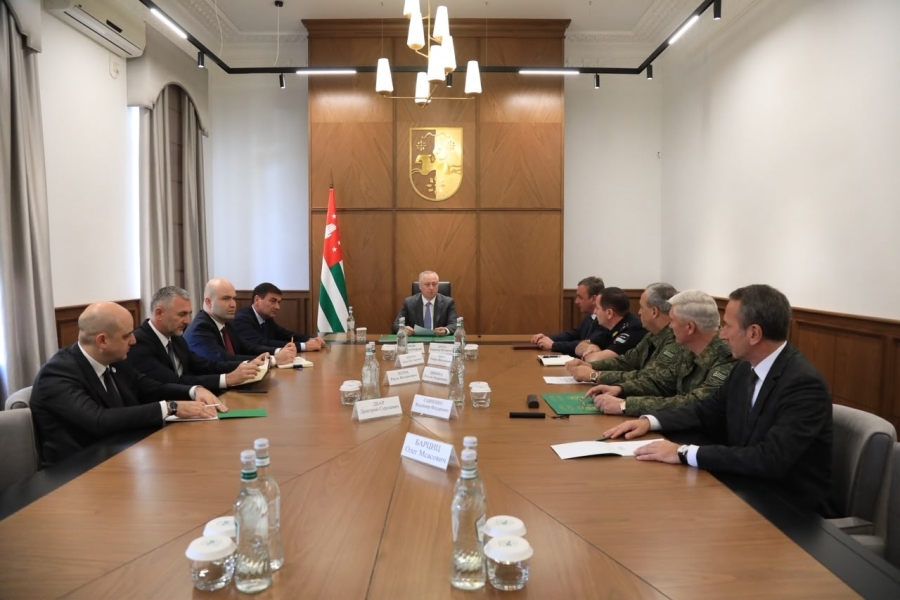
Opening the meeting, the Head of State noted that the main goals of the exercises are to improve troop command methods, gain practical experience for officers of the command and operational staff, and to practice interaction between the Armed Forces of the Republic of Abkhazia and the Russian Federation.
The exercises began with bringing the troops to the highest state of combat readiness. Issues of mobilization deployment are resolved by military commissariats in close cooperation with local government bodies.
The concept of the exercises is developed taking into account the prospects for the development of the military-political situation in the region, the use of high-tech means of warfare, and the need to develop new tactical approaches.
The exercises include practicing issues characteristic of modern combat, including in conditions of the likely enemy's use of high-tech means of command, reconnaissance, electronic warfare, and fire engagement. The plan's features include conducting command and staff exercises at all management levels, involving unit officer personnel in conditions close to combat, as well as increasing commanders' independence in decision-making.
The testing of new military complexes developed by domestic specialists, which are of significant importance for conducting combat operations, is also planned.
I pay special attention to the practical solution of all planned tasks. "They must be worked out by the staffs of all levels of troop command in full," emphasized Badra Gunba.
Then, at the Security Council meeting, the Chief of the General Staff of the Armed Forces of the Republic of Abkhazia, Vladimir Savchenko, gave a report. He reported to the Commander-in-Chief and members of the Security Council on the concept and main stages of the exercises, the planned measures for bringing troops to the highest state of combat readiness, the organization of troop grouping command, and the coordination of actions of the involved units.
After hearing the report of the Chief of the General Staff, Commander-in-Chief of the Armed Forces Badra Gunba gave a number of instructions to the members of the Security Council and the heads of state bodies involved in conducting the exercises.
The Commander-in-Chief noted that a wide range of tasks at sea is being practiced for the first time within the framework of the exercises. In this regard, he instructed the commanders of formations and military units to ensure strict compliance with safety requirements, and the Minister of Defense to organize control over their implementation.
The Prime Minister has been tasked with organizing comprehensive support for the Armed Forces, providing practical assistance, and overseeing the work of the territorial defense headquarters of the Republic of Abkhazia. The Cabinet of Ministers operational group is instructed to work on a permanent basis as part of the territorial defense headquarters.
During the exercises, parliament representatives need to make decisions on practical actions and participation in the planned events. Heads of law enforcement agencies are instructed to ensure the participation of their subordinates in solving the assigned tasks in accordance with the combat deployment.
The Ministry of Defense and the Chief of the General Staff – Commander of the troop grouping have been tasked with organizing the coordination of troop actions at all stages of the exercises.
Commander-in-Chief of the Armed Forces Badra Gunba announced that he had signed decrees appointing commanders of troop groupings. As the exercise commander, the commander-in-chief will work with the leadership staff on an individual plan.
The exercises, as last year, are large-scale. Thousands of soldiers and officers, reservists, are involved. "I hope that the skills and experience gained during these exercises will allow for the coordination of actions between various units and detachments," noted Badra Gunba.
The Commander-in-Chief ordered that detailed information on the progress of the exercises be presented to him daily.
In conclusion, Badra Gunba wished all participants success in their work for the benefit of strengthening the state's defense capabilities.